
By - Lalit Sharma - Omya International and Laura Soriano Romaní - AINIA Centro Tecnológico
In this article, researchers review the findings of a study on the bioavailability of different calcium salts.
Bioavailability plays a key role in pharmaceutical and nutraceutical applications. In pharmacology, bioavailability is a measurement of the extent to which a therapeutic substance is absorbed by the intestine and becomes available at the organ site. In nutritional science, it refers to the fraction of a nutrient that is absorbed and made available either for metabolic use or storage. A newly published study in the journal Food Chemistry looks at the bioavailability of different commercially available calcium salts [1].
An adequate daily calcium intake is essential for strong bones and teeth as well as properly functioning muscles and nerves. In addition to eating calcium-rich foods, consumers can support their daily intake with calcium supplements, pharmaceuticals, and fortified foods. However, ingesting the mineral in any form is not enough; to ensure proper absorption, the form of calcium needs to be adequately bioavailable and bioaccessible. Bioaccessibility is the amount of an ingested nutrient that is potentially available for absorption. In the case of calcium salts, the dissolved proportion in the gastric acid determines the bioaccessibility.
Characterization of the samples
In this study, researchers determined the bioaccessibility and bioavailability of Omyaforte 100—a functionalized calcium carbonate (FCC)—and compared it with other frequently used calcium sources: calcium citrate tetrahydrate (CCT), tricalcium phosphate (tri-CP), and calcium carbonate (CC). The calcium powders were characterized by measuring particle size, distribution, and porosity. Although CC and FCC showed the smallest particle sizes, significant differences were observed between the two.
The researchers concluded that porosity has a strong influence on the ingredients’ functionality.
The material’s porosity also affects its final solubility. In general, higher porosity enhances calcium solubilization. FCC showed a pore volume approximately three times that of the other samples. It was also characterized by the largest interparticle pore volume.
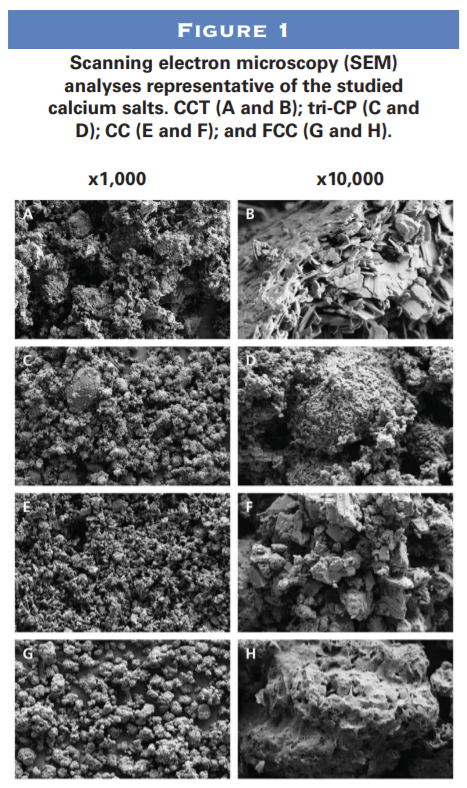
These results are in line with the morphological characterizations, where FCC demonstrated larger porous structures with less agglomeration compared to the other calcium sources. Scanning electron microscopy (SEM) analyses showed that FCC has a porous amorphous structure that favors a spherical shape (Figure 1). As a result, the structure improved the solubility of this calcium salt, contributing to an increase in the amount of soluble calcium. This partially explains the bioaccessibility results compared to the other calcium salts studied.
Bioaccessibility and bioavailability
To compare the samples’ bioaccessibility, the researchers tested 300 milligrams of elemental calcium contained in the calcium salt (30 percent of the daily recommendation of 1,000 milligrams) in an in-vitro dynamic gastrointestinal digestion system. All parameters were selected to reproduce the gastrointestinal conditions of a healthy adult after eating a solid meal. Results showed a similar calcium bioaccessibility for CCT (76.44 ± 9.73%), CC (73.7 ± 8.18%), and FCC (74.4 ± 1.87%) and a lower value for tri-CP (46.07 ± 8.68%) (Figure 2).

After simulating gastrointestinal digestion, the researchers studied the calcium’s intestinal absorption using a Caco-2 model that reproduces the conditions of intestinal cells at lab scale.These results suggest that the type of calcium salt may affect calcium bioavailability, since the uptake efficiency values varied (Figure 3). FCC was almost twice as biologically available as CC and CCT and generated a higher total intestinal uptake (5.68 ± 0.26%), compared to CC (3.93 ± 0.99%), CCT (3.41 ± 0.33%), and tri-CP (1.85 ± 0.34%). FCC’s composition, structure, increased porosity, fewer agglomerates, and particle size all help improve calcium solubility in the intestine, which explains its similar bioaccessibility but higher bioavailability compared to the other calcium salts.

Market potential
Efficient calcium ingredients for food fortification and dietary supplements need to release as much elemental calcium as possible for absorption in the gut. In this study, an innovative calcium source combined with structural modifications achieved better bioavailability values than the other commercial calcium salts tested. Thanks to a patented recrystallization process, FCC offers a new mineral composition and porous structure, which allows for faster access to gastric juices in the stomach. The accelerated dissolution in acidic environments results in a quicker release of calcium ions, which are then ready to be absorbed into the bloodstream via the small intestine.
The world’s increasingly aging population will likely drive demand for calcium supplements and other fortified products. FCC is an adequate and proven ingredient for calcium fortification. Since it combines both high levels of elemental calcium and effective calcium uptake, only a small amount of FCC is needed to reach recommended daily intakes. This calcium form presents new opportunities for manufacturers looking for nutritious, effective, and easy-to-process ingredients that address health-related aging concerns—from bone health blends to vitamin and mineral mixes, rehydration powders, and sports nutrition products.
Reference
- Nieto JA et al.: Improved in vitro bioavailability of a newly developed functionalized calcium carbonate salt as a food ingredient and its comparison with available commercial calcium salts. Food Chemistry. Volume 348. 30 June 2021. https://doi.org/10.1016/j.foodchem.2020.128740.
Lalit Sharma is innovation manager, food at Omya International (info.pharma@omya.com, omyaforte.omya.com). Laura Soriano Romaní, PhD, is R&D project manager at AINIA Centro Tecnológico.